
AI Lab Research Center

Turning AI into products for customer service and process management.

We bring academic research together with real-world experience to build intelligent solutions that learn from your data and work as an extension of your team.
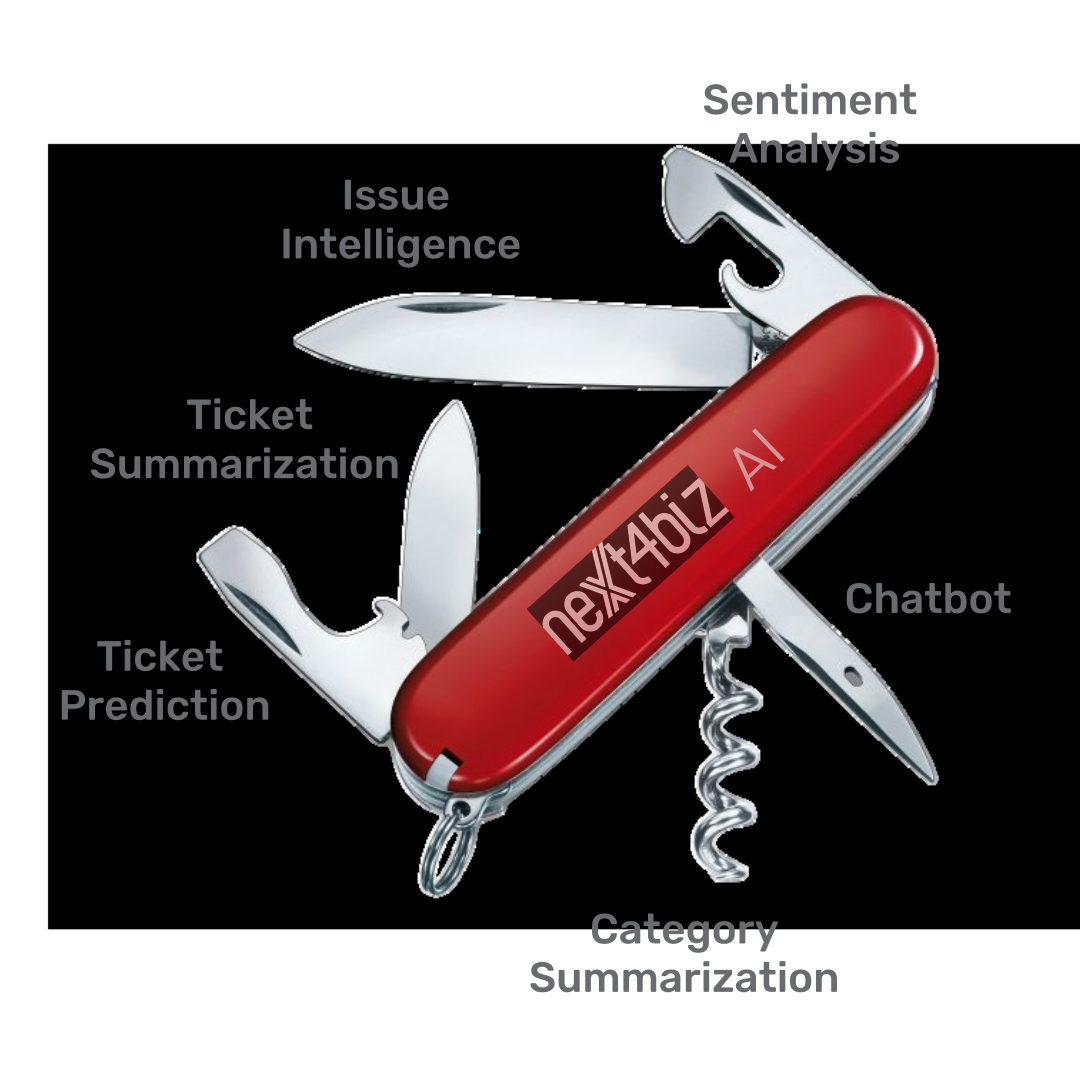
AI Lab

AI Throughout the Journey

AI-powered capabilities that enhance both Customer Service and Business Process Management

AI for Customer Service

AI Bots

Intelligent bots that handle conversations in chat channels — trained on your knowledge base, documents, and customer experiences. Resolve issues automatically or seamlessly hand off to agents with full context.

  • • LiveChat & WhatsApp AI Bots
  • • Hybrid Guided + LLM architecture
  • • Seamless human handoff
  • • Trained on your documents and experiences
Learn more →

Supervisor Bot

An LLM-powered agent assistant embedded in every step of customer service. It understands conversations, ticket context, and your policies — then proposes answers and next actions to help agents resolve faster.

  • • Real-time suggestions and policy guidance
  • • Action recommendations
  • • Trained on your documents and experiences
  • • Real-time guidance on agent screen
Learn more →

Issue Intelligence

Issue Intelligence first analyzes each issue and filters out noise; then, using what it has learned from historical issues and built-in categories, it determines the right category, priority, and routing decision.

  • • Separates real issues from noise
  • • Determines category, priority, and routing
  • • Automatically triggers the relevant workflow
  • • The same intelligent logic across every channel
Learn more →

AI Agent for Written Channels

Manage comments and complaints from written channels — email, social media, DMs, marketplaces, complaint sites, etc. — end-to-end automatically with Next4biz AI Agent, trained on your documents, website, experience, and web services.
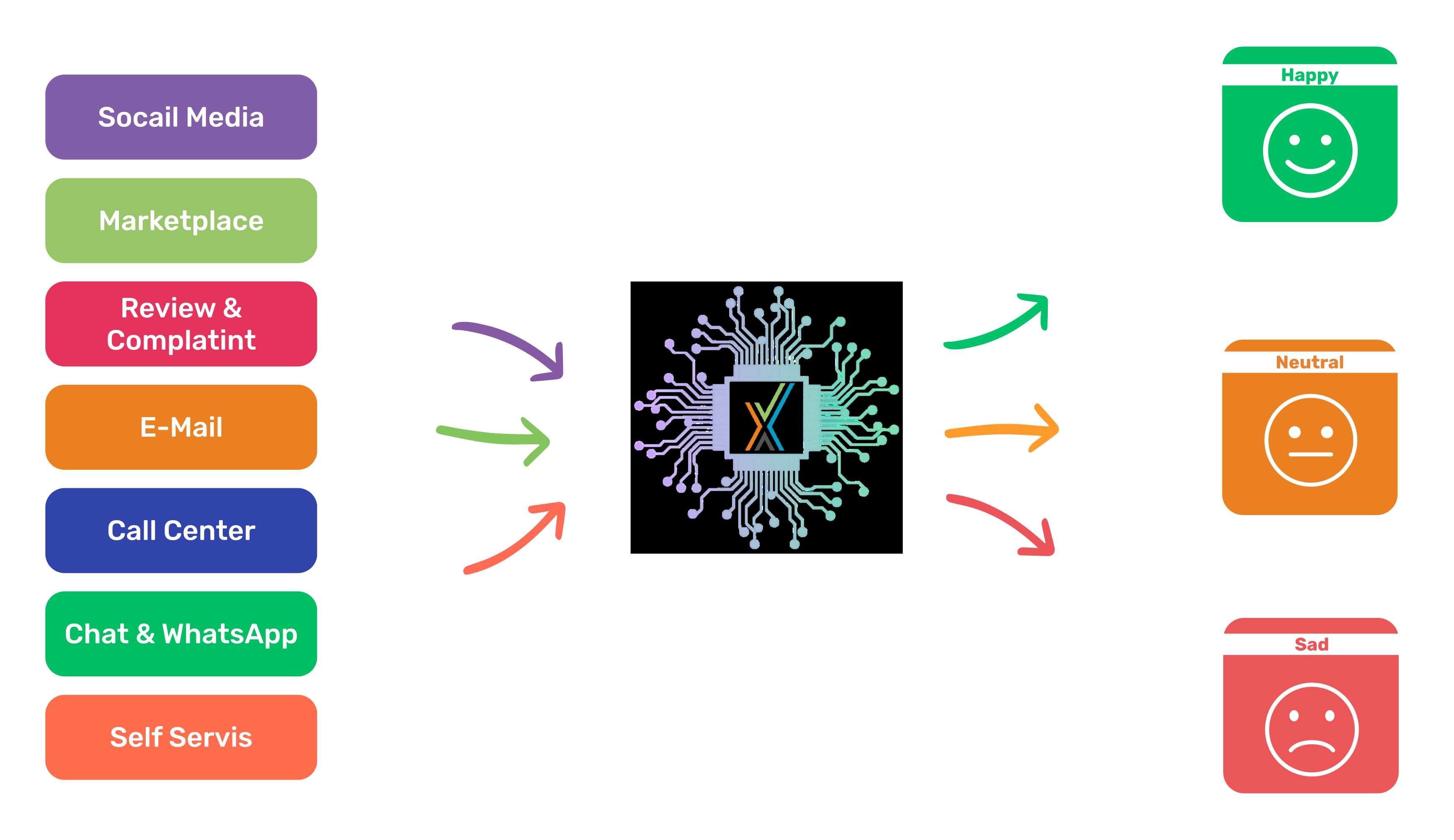
  • • Trained on your documents, website, experience, and web services
  • • Automatic classification
  • • AI-powered automatic responses in your brand voice
  • • Creates tickets and triggers relevant workflows when needed
Learn more →
Sentiment Analysis

AI Sentiment Analysis

Tag each ticket as positive/neutral/negative. Spot negative ones early and take action.

Learn more →
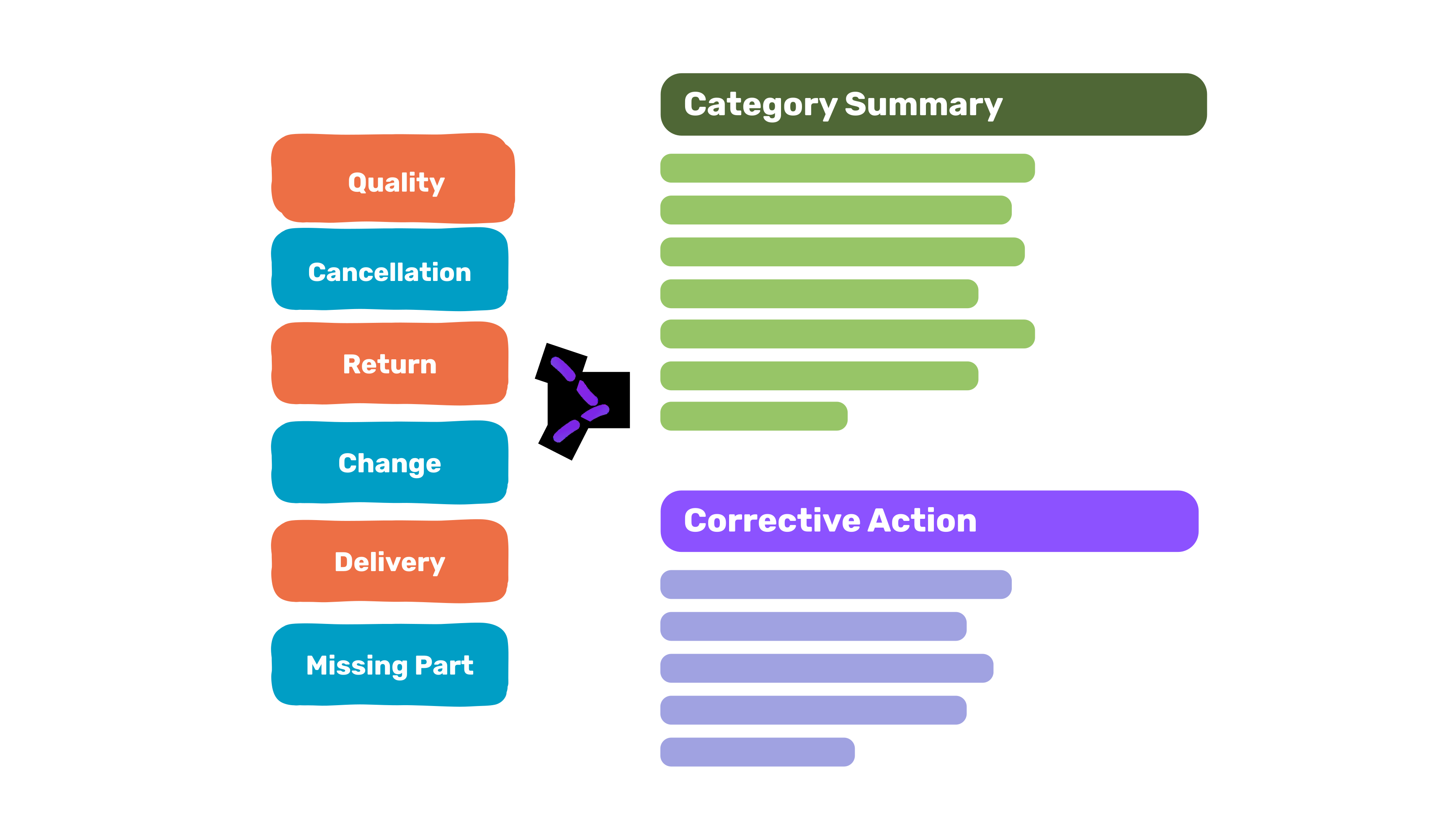
Category Summarization

AI Category Summarization

Summaries by category highlight patterns, root causes, and fixes to reduce recurrence. More →

AI Ticket Prediction

Predict how many tickets will come from each category; anticipate staffing needs and catch SLA risks early.

Learn more →

Customer Sentiment Analysis and Scoring

Research on advanced sentiment analysis techniques for customer service applications, improving accuracy in understanding customer emotions and satisfaction levels.

Read Article

Anomaly Detection in Business Processes: Next4biz EIAD Model

Research on Edge Information Assisted Decoder (EIAD) for business process anomaly detection, achieving improved F1-score from 0.32 to 0.63 using graph attention networks and edge-conditioned convolution.

Read Article

AI for Business Process Management

Coming Soon

Anomaly.net: Advanced Process Analytics

In the digital transformation era, efficient business process management depends on high-quality Business Process Management (BPM) solutions. These solutions naturally generate large amounts of data as process event logs—digital reflections of real-world operational flows.

Understanding anomalies in your processes is critical for operational excellence. Anomalies can indicate inefficiencies, bottlenecks, compliance issues, or potential risks that could lead to significant losses.

The upcoming Anomaly.net module will analyze your process logs using multi-graph structures, graph neural networks (GNN), and Transformer-based architectures to automatically detect anomalies, non-standard flows, and bottlenecks. It works with both design-time process models and production data, providing comprehensive insights across your entire process lifecycle.

  • • Multi-graph architecture for complex relationships
  • • Graph Neural Networks for superior accuracy
  • • Transformer architecture for faster processing (up to 60% faster)
  • • Works with both design-time and production data
  • • Up to 22% better anomaly detection performance

Research & Development

Backed by cutting-edge research published in IEEE Access. The model achieves up to 22% better performance compared to state-of-the-art approaches, while reducing processing time by up to 60%.

Learn more →
Planned for Late 2026

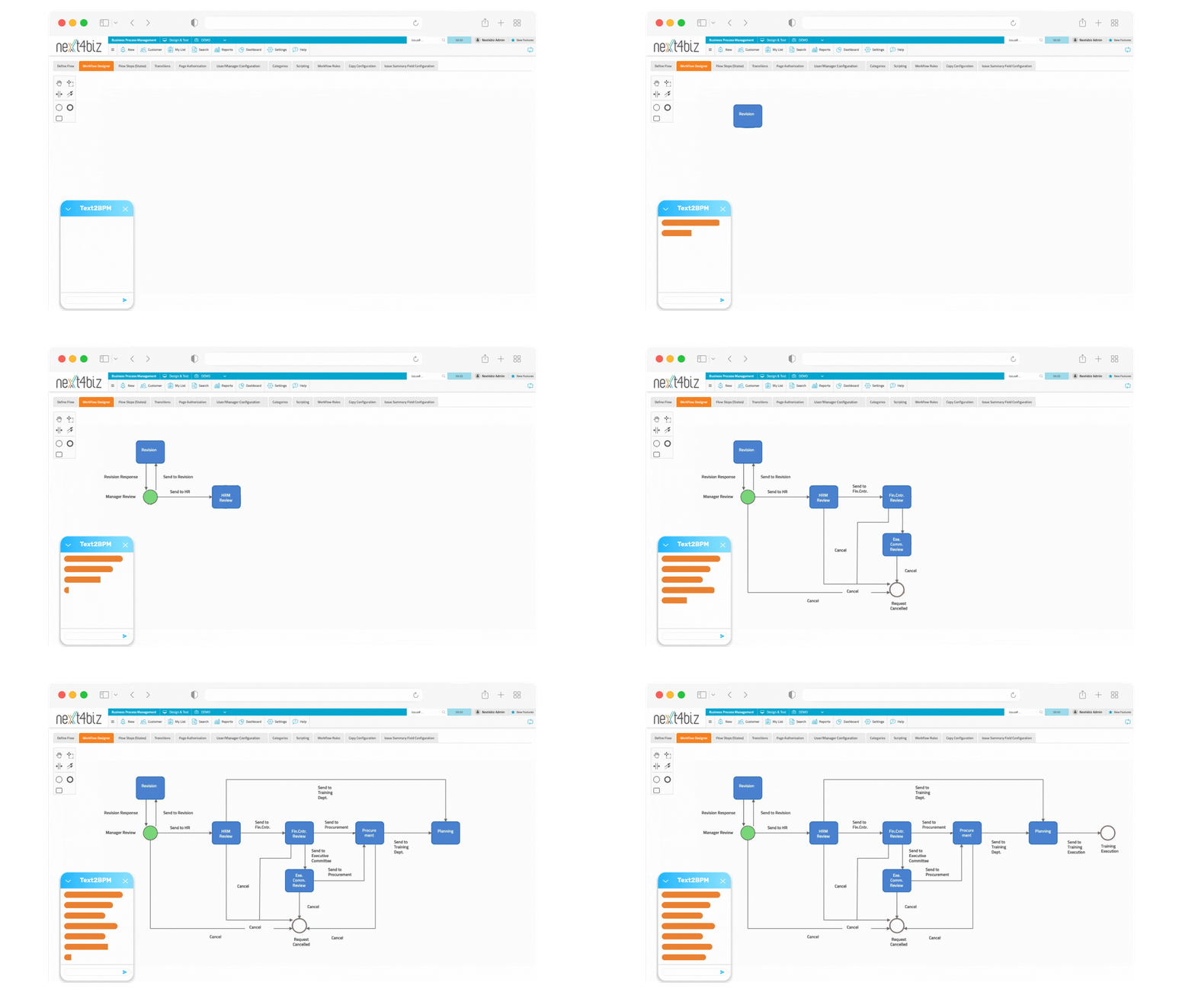
Text2BPM: From Natural Language to BPMN

Automatically convert natural-language process descriptions into BPMN 2.0-compliant workflows. Combines large language models (LLMs), knowledge graphs (KG), and graph neural networks (GNNs).
Learn more →

Research & Development

Our research-driven approach ensures that Next4biz products are built on cutting-edge AI technologies

New Publication Cluster Computing (Springer Nature) · Q1 · Impact Factor 5.5

SPECTRE: Decontamination and Anomaly Detection on Business Process Event Logs

Prepared by our R&D Center researchers in academic collaboration, SPECTRE is an unsupervised, multi-purpose autoencoder model that cleans erroneous data in business process event logs and detects process anomalies. Tested on 11 datasets, the study achieved up to 99.94% decontamination accuracy and a 0.996 F1 score in event-level anomaly detection, and was published in Cluster Computing, indexed by SCIE and Scopus.

Read the Article

The Role of Suffixes in Turkish Text Classification and NLP Applications

Research on Turkish language processing, exploring how affixes contribute to text classification accuracy and improving NLP applications for Turkish-speaking markets.

Read Article

Improving Next4biz Chatbot Efficiency

Research on enhancing chatbot performance through advanced training techniques and optimization methods, resulting in improved response accuracy and customer satisfaction.

Read Article

ASYU 2024 Best Paper Award

Next4biz research team won the best paper award at ASYU 2024, recognizing our contributions to AI and natural language processing in business applications.

Read Article

AnomalyNet: Multi-Graph Model and Transformer Architecture

Research published in IEEE Access on multi-graph structures and graph autoencoders for business process anomaly detection. Achieves up to 20% higher performance and 60% faster training and inference time using Transformer architecture.

Read Article

Academic Papers

SPECTRE: a multi-purpose autoencoder model for decontamination and anomaly detection on anomalous business process event logs

Venue: Cluster Computing (Springer Nature)
Scope: International
Date: July 14, 2026
Paper

Benchmarking xLSTM Architecture for Business Process Anomaly Detection

Venue: Kocaeli Journal of Science and Engineering
Scope: International
Date: June 29, 2026
Paper

LeanTrace: A Resource-Conscious Lightweight Solution for Trace-Level Detection of Business Process Anomalies

Venue: ASYU 2025 – Innovations in Intelligent Systems and Applications Conference
Scope: International
Date: September 10, 2025
Paper

Fidelity-Driven Evaluation of XAI Techniques for Fraud Detection in Decentralized Loyalty Platforms

Venue: ASYU 2025 – Innovations in Intelligent Systems and Applications Conference
Scope: International
Date: September 10, 2025
Paper

Enhancing Business Process Anomaly Detection with Sequence Capturing Hybrid Autoencoders

Venue: ISAS 2025 – 9th International Symposium on Innovative Approaches in Smart Technologies
Scope: International
Date: June 27, 2025
Paper

Graph Based Business Process Anomaly Detection with Edge Feature Reconstruction and Advanced Linear Networks

Venue: 7th International Congress on Human-Computer Interaction, Optimization and Robotic Applications
Scope: International
Date: May 23, 2025
Paper

Multi-Graph Anomaly Detection in Business Processes With Scalable Neural Architectures

Venue: IEEE Access
Scope: International
Date: February 21, 2025
Paper

Edge Information Assisted Decoder for Business Process Anomaly Detection

Venue: 8th International Artificial Intelligence and Data Processing Symposium IDAP’24
Scope: International
Date: September 21, 2024
Paper

Transformative Approaches to Customer Sentiment Analysis and Customer Feedback Scoring in CRM Platforms

Venue: 8th International Artificial Intelligence and Data Processing Symposium IDAP’24
Scope: International
Date: September 21, 2024
Paper

Evaluating Turkish BERT-based Language Models for Effective Customer Feedback Interpretation in CRM

Venue: UBMK 2024 – 9th International Conference on Computer Science and Engineering
Scope: International
Date: October 26, 2024
Paper

Business Process Management Anomaly Detection Through Semantic Embedding-Integrated Graph Neural Networks

Venue: UBMK 2024 – 9th International Conference on Computer Science and Engineering
Scope: International
Date: October 26, 2024
Paper

Multi-Aspect Anomaly Detection with Graph Neural Networks and Kolmogorov-Arnold Networks in Business Process Management

Venue: UBMK 2024 – 9th International Conference on Computer Science and Engineering
Scope: International
Date: October 26, 2024
Paper

Enhancing RAG Pipeline Performance with Translation-Based Embedding Strategies for Non-English Documents

Venue: ASYU 2024 – Innovations in Intelligent Systems and Applications Conference
Scope: International
Date: October 16, 2024
Paper

Semi-supervised Detection of Contaminated Business Process Instances using Graph Autoencoders and Dynamic Edge Convolutions for BPM Anomaly Detection

Venue: ASYU 2024 – Innovations in Intelligent Systems and Applications Conference
Scope: International
Date: October 16, 2024
Paper

Boosting CRM Chatbot Solutions with Flash Attention and Probabilistic Inference

Venue: ISPR 2024 · 4th International Conference on Intelligent Systems and Pattern Recognition
Scope: International
Date: March 2, 2025
Paper

Enhancing Targeting in CRM Campaigns through Explainable AI

Venue: INFUS 2024 · International Conference on Intelligent and Fuzzy Systems
Scope: International
Date: September 1, 2024
Paper

Yeni Nesil Sadakat Programlarında Blokzincir Ve Akıllı Sözleşmeler ile Müşteri Bağlılığının Artırılması [Increasing Customer Loyalty with Blockchain and Smart Contracts in Next-Generation Loyalty Programs]

Venue: 3. Uluslararası Topkapı Bilimsel Araştırmalarda Güncel Gelişmeler Kongresi [3rd International Topkapı Congress on Current Developments in Scientific Research]
Scope: International
Date: May 1, 2024
Paper

İş Akışı Yönetiminde Anormallik Tespiti Üzerine Bir Uygulama [An Application on Anomaly Detection in Workflow Management]

Venue: II. Bilsel Uluslararası Gordion Bilimsel Araştırmalar Kongresi [2nd Bilsel International Gordion Scientific Researches Congress]
Scope: International
Date: March 10, 2024
Paper

Identifying Anomalies in Customer Satisfaction for Strategic Customer Retention

Venue: 5. ArgeInv: V. Ulusal Üniversite-Sanayi İşbirliği, Ar-Ge ve İnovasyon Kongresi [5th National Congress on University-Industry Collaboration, R&D and Innovation]
Scope: National
Date: December 14, 2023
Paper

Hiper-Parametre Ayarlamasının Kampanya Başarı Tahmini Üzerindeki Etkisi [The Impact of Hyper-Parameter Tuning On Campaign Success Prediction]

Venue: 12. Uluslararası Bilimsel Çalışmalar Kongresi (UBCAK) [12th International Congress on Scientific Studies]
Scope: International
Date: September 20, 2023
Paper

Öngörücü Müşteri Memnuniyeti için Derin Öğrenme ve Öğrenme Aktarımına Dayalı Modelleme [Deep Learning and Transfer Learning Based Modeling for Predictive Customer Satisfaction]

Venue: 12. Uluslararası Bilimsel Çalışmalar Kongresi (UBCAK) [12th International Congress on Scientific Studies]
Scope: International
Date: September 20, 2023
Paper

Müşteri İlişkileri Yönetiminde Doğal Dil İşleme Tabanlı Metin Segmentasyonu Üzerine Bir Uygulama [An Application on Natural Language Processing Based Text Segmentation in Customer Relationship Management]

Venue: III. Uluslararası Akdeniz Bilimsel Araştırmalar Kongresi [3rd International Mediterranean Congress]
Scope: International
Date: April 17, 2023
Paper

Potansiyel Müşteri Segmentasyonu Uygulaması [A Lead Segmentation Application]

Venue: II. Uluslararası İktisadi ve İdari Bilimler Kongresi [2nd International Congress on Economics and Administrative Sciences]
Scope: International
Date: January 20, 2023
Paper

A Dimension Reduction Study for Campaign Success Prediction

Venue: 9. Uluslararası Bilimsel Çalışmalar Kongresi (UBCAK) [9th International Congress on Scientific Studies]
Scope: International
Date: August 4, 2022
Paper

Kampanya Başarısı Tahmininde Öznitelik Seçimi [Feature Selection in Campaign Success Prediction]

Venue: 9th International Conference on Future Learning and Informatics
Scope: International
Date: October 9, 2022
Paper

Alışveriş Sıklığı Düşük Sektörler İçin Kayıp Müşteri Analizi [Customer Churn Analysis for Sectors With Low Shopping Frequency]

Venue: IV. International Halich Congress on Multidisciplinary Scientific Research
Scope: International
Date: August 4, 2022
Paper

Türkçe Metinlerin Sınıflandırılmasında Öznitelik Olarak Eklerin de Kullanılması [Using Suffix as Features Classification of Turkish Texts]

Venue: International Symposium on Advanced Engineering Technologies (ISADET)
Scope: International
Date: June 17, 2022
Paper

Türkiye’deki Şirketlerin Müşteri Yaşam Boyu Değeri Hesaplamaları İçin Bir Öneri [A Proposal to Customer Lifetime Value Calculations of Companies in Turkey]

Venue: International Symposium on Advanced Engineering Technologies (ISADET)
Scope: International
Date: June 16, 2022
Paper

Frequently Asked Questions About the AI Lab

The most common questions about how the models are developed through Next4biz's own R&D, what data they are trained on, and how their accuracy is monitored after deployment.

Is Next4biz's AI genuinely its own R&D work, or does it just amount to calling a ready-made language model API?

It is our own R&D. Next4biz operates as a registered R&D center, with PhD-level and professor-titled researchers on its staff. The work has been published in IEEE Access and in Springer Nature's Cluster Computing journal, and has won best paper awards at the ASYU and UBMK conferences. That research finds its way into the product: sentiment analysis, Issue Intelligence and the forthcoming Anomaly.net module are outputs of these studies. Building a prototype is easy; productizing it with data cleaning, model selection, multi-criteria evaluation and observability layers is the real work. Why Next4biz →

How do you ensure data quality in AI training — is raw ticket data fed straight into the model?

No, the data is cleaned before it touches the model; a strong model cannot compensate for low-quality data, it learns the errors in it as well. First a language and meaning filter removes the noise. Then repeated examples are cleaned out by semantic similarity; the aim is not to shrink the volume but to prevent the same example landing in both the training and the test set and distorting the measurement — that is, to prevent data leakage. Class imbalance is corrected only in the training set; the test set keeps the real-world distribution so that the results reflect the field.

If the AI gives correct answers, is that enough? How do you know it has genuinely learned the right thing?

It is not enough; a correct output is not proof of correct learning. The "Clever Hans effect" in machine learning describes this: the horse that appeared to solve arithmetic was actually reading people's body language. So in evaluation we do not settle for a single accuracy score; the model's errors are read in a confusion matrix. If two categories are constantly confused, or the model retreats into catch-all categories such as "General", the problem may lie in the category definitions; those findings are handed back to you as a proposal for an ideal category tree.

How does Next4biz decide which model to use for a task — what does "champion model" mean?

No project starts with a single architecture. Transformer classifiers, embedding-based structures, locally adapted models and hybrids compete on the same training and validation splits; the winner goes into production as the "champion model". The criterion is not overall accuracy alone: per-class recall, confidence calibration, latency, model size and running cost are all weighed together. Experiments are designed to be reproducible. Which language model runs on the platform is answered on the AI page. Our AI approach →

Won't the model's performance degrade over time after deployment — how do you monitor that?

It can; the model stays fixed while the world changes, so going into production is the beginning of the work, not the end. Different kinds of drift are monitored: data drift (the language of complaints changing after a new mobile app release), concept drift ("my card doesn't work" shifting from a physical card to a digital payment problem) and taxonomy drift (a growing category needing sub-branches). The monitor, detect, find the root cause, improve loop runs continuously; retraining is only one of the options. Decisions the agents correct are fed back into the model as well.

Our knowledge base is not in English; how do you improve the accuracy of finding the right context in a document-grounded bot?

In retrieval-augmented generation (RAG), finding the right passage determines the quality of the answer; multilingual embedding models remain weaker on non-English text. A study our R&D team presented at ASYU showed that translating documents into English first and producing the embedding vectors over the translation — while keeping the original text — improves context precision and recall. This approach is used in Next4biz chatbot systems. Summary of the study →