Guided Bot
Common requests that can be resolved with menu guidance. The customer picks a topic; the status of their record comes from your integrated systems.

Bots handle conversations on live chat and WhatsApp, trained on your knowledge base, documents and real CX history. They resolve the request inside the chat or hand the conversation to an agent with full context.
The bot can complete many requests end-to-end: answer, status check, update, ticket creation. When a case needs an approval, a missing document or another team, it starts the right workflow.
When agents take over, they see the full bot conversation, the customer's orders and products, the ticket history across channels, plus sentiment analysis and the customer satisfaction score. The same bot runs on your website, inside your authenticated web app via SSO, in your mobile app with our SDK, and on WhatsApp.
Common requests that can be resolved with menu guidance. The customer picks a topic; the status of their record comes from your integrated systems.
Free-text requests without a menu; LLM Bot understands the question and resolves it with your documents and web services.
Requests that need approval or review; the agent takes over the conversation with its full history and records, so the customer doesn't start over.
You decide the setup: hybrid (Guided Bot + LLM Bot) or LLM Bot only.
AI agents that monitor channels, categorize tickets, draft responses and trigger workflows. Email, social media, review platforms, marketplaces, self-service and the call center are handled in the same structure.
PRIME (Priority Ranking & Interaction Management Engine) meets the incoming flow from email and social media at the gate. Emojis, short contextless content, irrelevant messages from automated mailing lists and misrouted emails are filtered out or marked as low priority; every valid message gets a type and a priority.
Auto-Responder pulls the information it needs from your systems (order, delivery or account status, for example) and replies in the channel the request came from. A request that cannot be resolved automatically, or that needs a workflow, goes to Issue Intelligence.
Monitors designated support inboxes, filters irrelevant messages and resolves suitable requests with approved templates and integrations.
How it works →Monitors comments, mentions and DMs on Facebook, Instagram, X and LinkedIn, and drafts brand-safe replies.
How it works →Monitors Google, Apple/Play stores, Trustpilot and Şikayetvar; turns relevant reviews into tickets and posts replies back to the platform.
How it works →Monitors product-page Q&A sections on marketplaces, posts seller replies back and triggers workflows such as returns, exchanges or shipping checks.
How it works →On your website or mobile app, predicts the category and asks for missing information; creates the ticket and resolves it when possible.
How it works →Recognizes the customer during the call; shows open tickets, customer data and the satisfaction score, and completes the transaction when possible.
How it works →Using what it has learned from past tickets and established categories, Issue Intelligence automatically determines the category of a new ticket, regardless of the channel it comes from. Based on that category it starts the related workflow or automation, reducing manual categorization and preventing misrouting.
In the call center it guides the agent during the conversation, so the right information is collected and the ticket lands in the right category. In written channels, tickets from email, social media, review platforms and marketplaces go through the same intelligent classification.
An LLM-powered assistant embedded in every step of customer service and resolution. It understands intent, ticket context and your policies; it drafts answers, proposes next steps and surfaces the right knowledge, so agents, supervisors and back-office teams resolve faster with confidence.
It can be trained on your knowledge base, product guides, internal documents, past tickets and CX team learnings, capturing patterns from similar cases. It shows likely causes, step-by-step resolution, policy nuances and warnings; it suggests the right questions and drafts a reply or internal note.
InsightX (Summarization Services) reviews the tickets in the categories you select, or across all of customer service, for the date range you set, using the AI summarization service, and answers the question leadership wants answered. You choose the scope: a few categories or all of customer service.
The topics customers complained about most in the selected period.
The most prominent sources of dissatisfaction; which topic bothers customers most.
Theme distribution and the root cause behind each theme.
Corrective action recommendations and easy wins you can act on right away.
Analyzes the emotional tone of each ticket and attaches a sentiment tag (positive, negative or neutral). A five-level satisfaction score from all of a customer's tickets flags customers at risk of churn early.
Forecasts the expected number of tickets in each category for upcoming periods, so teams can plan resources and see volume peaks in advance.
Presents the complete ticket lifecycle, from the first contact to the actions teams took in the workflow, in a concise summary.
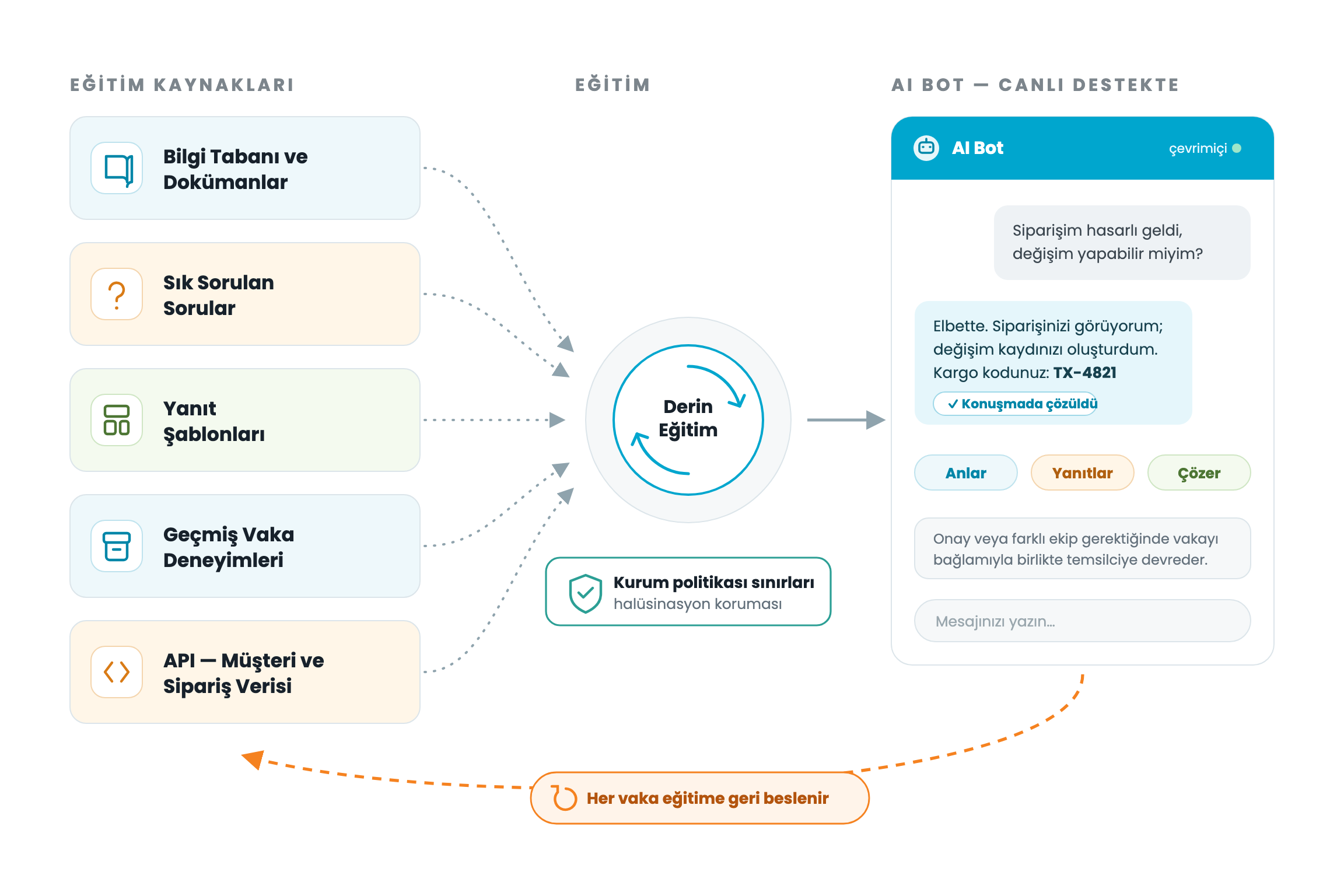
AI trained for you: it learns from your organization's own sources and answers within the limits of your policies.
Training draws on your organization's own knowledge: your knowledge base and documents, FAQs, reply templates and past case experience. It reaches customer and order data through APIs.
It works within the limits of your policies, which protect against hallucination. When an approval or another team is needed, it hands the case over to an agent with its context. Every case feeds back into training, so the AI gets to know your organization better the more it is used.
Can we automatically respond to a large portion of our calls by processing this data with an artificial intelligence mechanism? Can AI handle this? We honestly imagined whether AI could handle this, and now we see it coming true with this solution.
The feature of automatically converting reviews coming from various sites into records also enables us to track our customers from every channel. In addition, we do the classification here automatically with artificial intelligence support.
Since questions that cannot be answered by artificial intelligence are automatically transferred to relevant units by the system, quick response by employees is ensured.
The most common questions about how AI works in customer service, what data feeds it and how it is measured.
At three stages of the customer journey. At capture: bots run chat and WhatsApp, PRIME filters out the noise, Issue Intelligence categorizes. At resolution: the Supervisor Bot offers the agent a draft reply and policy guidance. At analysis: sentiment analysis, churn score, InsightX summaries and ticket forecasting are produced. For a comparison where AI is part of the package rather than an add-on: next4biz as a Zoho Desk alternative →
They exist for different jobs. If a large share of complaints falls into a few categories, and the questions and the integrations needed to resolve them are known, the Guided Bot resolves those requests through menus: the customer chooses, the bot completes the request. Requests outside the menus that require understanding free text and producing a solution bring in the LLM Bot. Whether to use a hybrid (Guided + LLM) or an LLM-only bot is decided by the organization's needs.
PRIME (Priority Ranking & Interaction Management Engine) listens to every written channel and decides at the door whether a piece of content is really a ticket that needs handling. Emojis, short contextless content and misdirected emails are filtered out; every valid message is assigned a type and an operational priority. PRIME →
Your organization's knowledge base, product manuals, internal documents, past resolutions and live data from integrated systems (orders, products, SLAs). Issue Intelligence also learns from past tickets and your existing category tree to classify consistently across all channels. General internet knowledge is not a source for answers. Issue Intelligence →
The business team manages it. The category tree, Guided Bot scenarios, message templates and business rules are defined with visual editors; model training and the infrastructure side stay with Next4biz. You do not need to hire a data scientist or learn to write prompts; monitoring and improving model quality is also carried out by Next4biz. Implementation and training →
We are not tied to a single model. We continuously evaluate well-known, proven large language models, determine the leading model for each period and run that one on the platform. This approach means leaps in model performance reach the product without requiring a migration project on your side.
Yes. We offer three options. By default the leading model runs as a managed service. If on-premise is requested, one of the models that support on-premise deployment is run on infrastructure you determine, under your organization's control. If data must not leave the country, it is stored and processed locally, and we run model training on our own servers hosted in that region without requiring hardware from you. Data centers and certificates →
The Guided Bot only moves within defined scenarios and pulls real data from integrations, so there is little room to make things up. When the LLM steps in and the flow stalls, the conversation is handed to a human agent with its full history. Every step — bot prompts, user input, AI suggestions, actions taken — is recorded and auditable.
Tickets resolved by the bot and those transferred to an agent are reported separately; the effect on first contact resolution and average handling time is tracked. InsightX shows which problem recurs, and ticket forecasting shows the load of the coming period. The intended benefits are defined together at the start of the project and tracked in the same dashboards. InsightX →
See our presentation and demos in a meeting with our product consultants, and let’s evaluate our autonomous customer service architecture together on your own channels and processes.
During the meeting, you can review with our experts: