
Reduce IT dependency
Business units design and evolve workflows, forms, scenarios, and templates according to their needs. IT's load decreases; business units' agility increases.
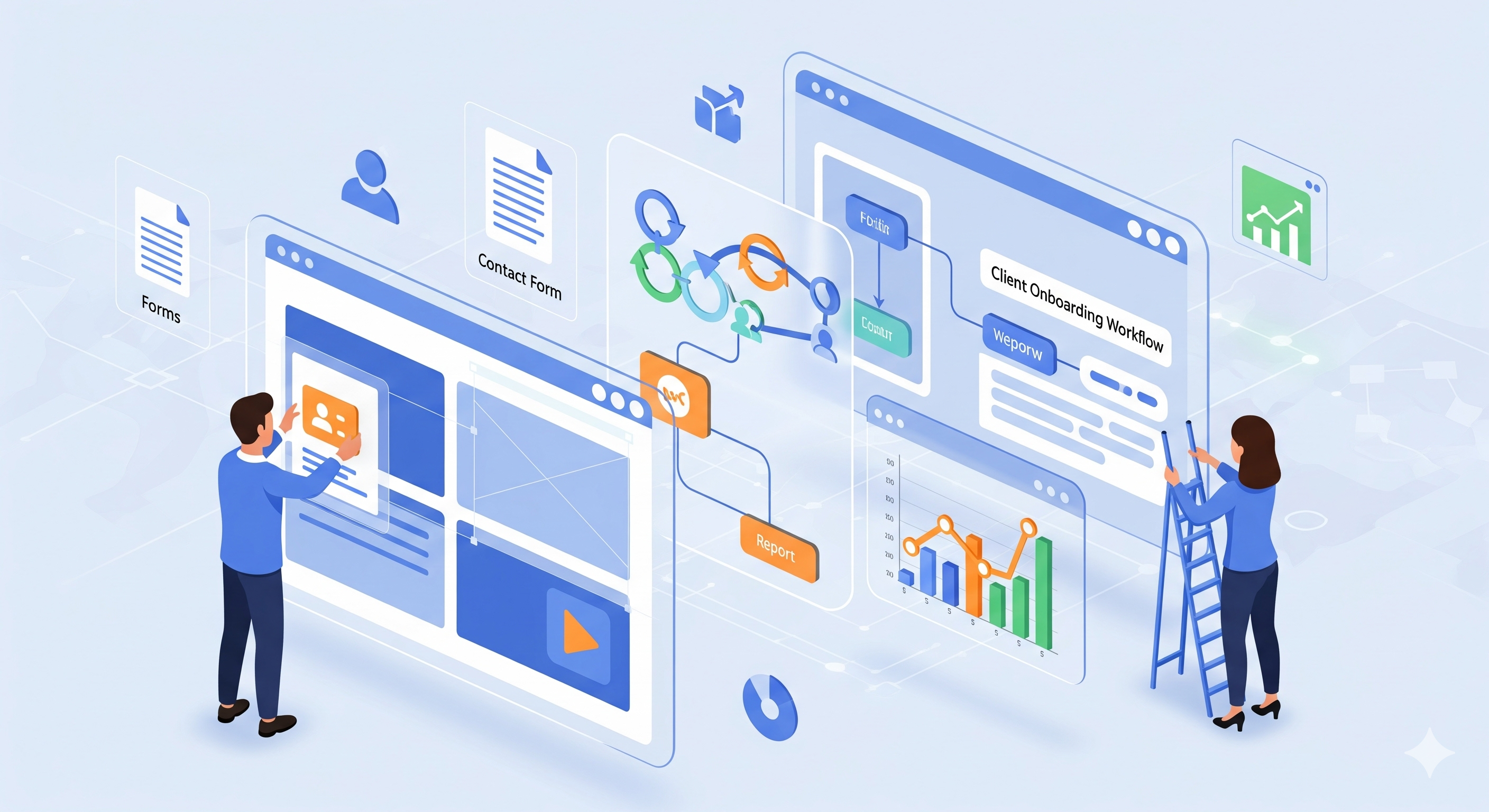
Next4biz CSM is built for no-code customization. Business-friendly editors let you design and evolve workflows, forms, agent scripts, and templates — without writing code.
Minimal training required: Business units who know the requirements can adapt the product. Visual editors make it intuitive and safe to design and apply changes.
No IT dependency: Business units design and update forms, workflows, rules, and scenarios without waiting for IT or vendors.
Fast adaptation: Configure fields, validations, and SLAs per category in minutes. Your changes show up in the product immediately.
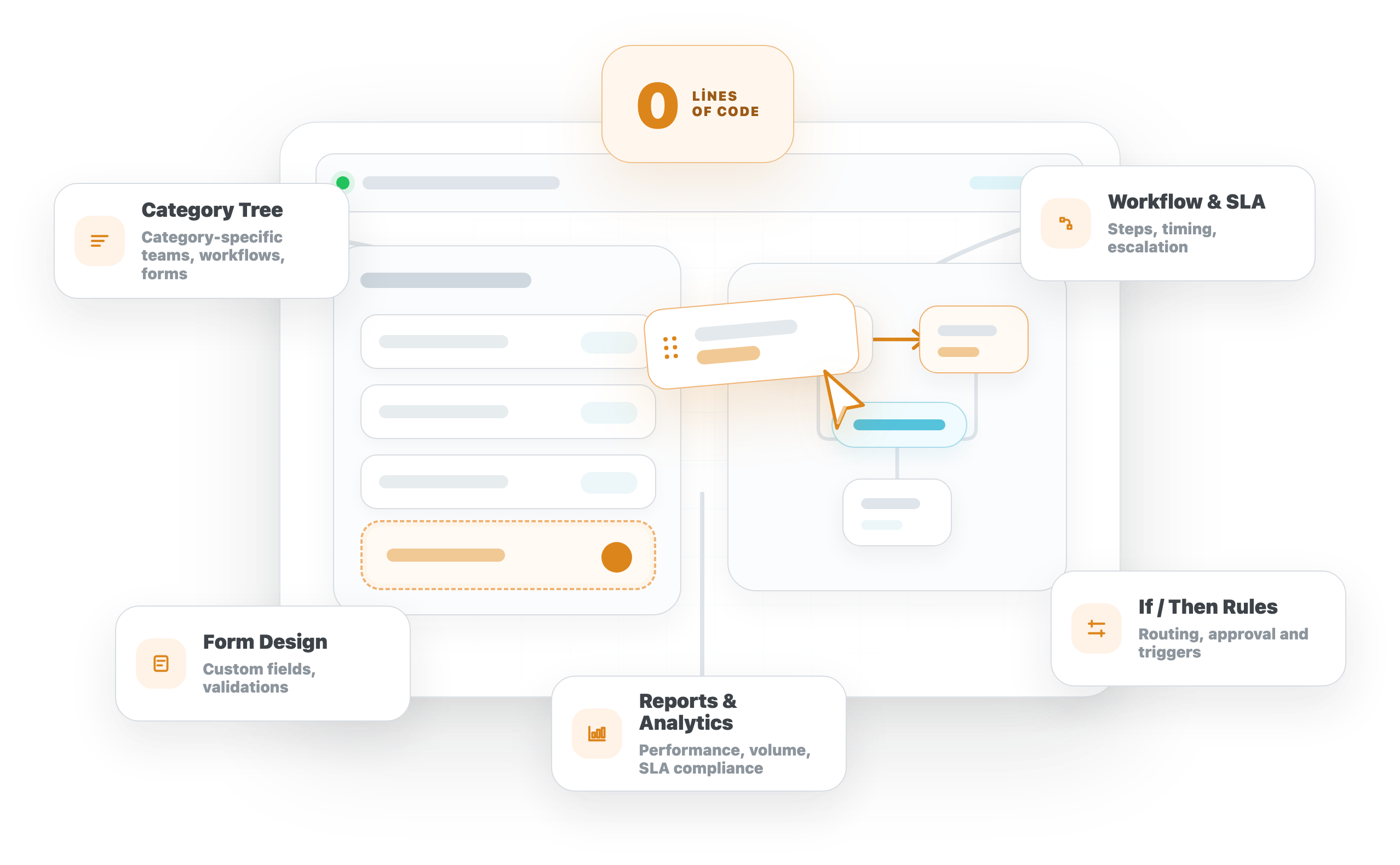
Define categories and subcategories; assign responsible groups, workflows and forms.
Design category-specific workflows with no-code editors; define SLA targets and escalations.
Design category-specific interfaces (forms, data fields, form rules).
Define if/then rules for routing, approvals, notifications, and triggers.
Design category-specific scenarios that guide agents through structured, consistent interactions.
Greet customers with rule-based menus, and route to an LLM bot or a live agent when needed.
Create ready-to-use templates for email and chat, so teams respond with consistent language.
Track volume, SLA compliance, and team performance — then spot improvement opportunities.
Iterate directly in no-code editors. Update forms, workflows, and rules per category without waiting for IT backlogs.
Set up ERP/CRM connections once. While CX teams structure customer service, IT focuses on security and integrations.
Manage changes safely with authorization and auditability; maintain compliance while enabling agility.
No-code architecture enables not only designing for today's needs but also quickly adapting to tomorrow's. Thus flexibility turns into true agility.
Outcome: Faster time-to-value, responsiveness to market/policy changes, and consistent execution across teams.
Outcome: IT reclaims capacity for security, data, and integration excellence while the business continuously optimizes operations.
Adapt new categories, workflows, forms, business rules, and more in days.
Less maintenance and renewal cost due to lower IT or vendor dependency.
Changes apply uniformly; less variance across agents/teams.
Changes, regulations, policy updates — adapt immediately.
The questions asked most often by those wondering what can be changed without writing code, who can do it, and how a faulty configuration is contained in production.
Every layer of the operation that changes day to day: the category tree, workflows with SLAs and escalations, forms and form rules, business rules, agent scenarios, Guided Bot scenarios, message templates, reports and analytics. All of it is managed from visual editors; business teams can change it without raising a software development request.
For day-to-day changes, yes: form, flow, rule, scenario and template updates stay with the business team and require no vendor change request. IT stays involved at setup and at the integration layer — SSO, ERP/OMS/CRM connections, role-based access policies. In the words used on this page: no line of code is written except for integrations.
A staff member who can document business processes can design or change a process; the visual editors make configuration intuitive. No software knowledge or consultancy is required — an operations lead can, for example, define the form and the workflow for a new category themselves. During the adaptation phase, teams are given onboarding, hands-on workshops and training. Implementation and training →
Permissions and the change log limit that risk. Role-based permissions define who can change what; who changed what and when is traceable. A faulty configuration is corrected immediately from the same editor and the correction appears in the product straight away. To test and preview workflow changes before publishing them, see the end-to-end request management page. Workflow changes →
No, that is IT's domain. Core systems (SSO, ERP, OMS, CRM) are connected once to the Next4biz Inventory. Once the connection is established, business teams can use that integrated data in workflows, forms and screens without writing code. In other words the integration is built once, and after that the business side is free to move.
In parameterized software you only tick predefined options. In a no-code architecture the business logic itself is built visually: the category tree, forms and data fields, workflows, SLAs and escalations, if/then business rules, scenarios, templates, permissions and reports are designed by the business unit. A new campaign, a regulatory change or a new product goes live as a new category and flow, without waiting for a quote from the vendor. Why Next4biz →
Routine change requests drop; IT focuses on security, data and integration. Some integrations are ready out of the box: communication channels (email, WhatsApp, social media, marketplaces, review platforms) and pre-built connectors for common enterprise software. IT connects core systems such as SSO and ERP/CRM, plus any organization-specific systems, once; business teams then use that data without touching the integration. Role-based access and the change log are built in, and because vendor change requests decrease, total cost of ownership falls.
The most visible indicator is how quickly a new category, campaign or policy goes live. Alongside it: the number of change requests raised with IT, the number of development requests sent to the vendor, and the time taken to comply with regulatory changes. Because changes are published uniformly, inconsistency between brands also decreases.