
Automatically Classify Issues
Issue Intelligence first analyzes each issue and filters out noise; then, using what it has learned from historical issues and built-in categories, it determines the right category, priority, and routing decision.
Emojis, irrelevant messages from automated email lists, misrouted support emails, and contextless content are filtered out or marked as low priority.
Using historical issues and built-in categories, it automatically determines the issue type, topic, and context.
Intelligent classification simplifies issue routing, improves response efficiency, and helps every issue reach the right team.
Even when the channel changes, the same intelligent categorization logic is applied, reducing manual effort and operational errors.
The service that filters the noise at the gate is PRIME — Priority Ranking & Interaction Management Engine. It listens to all written channels and decides whether each incoming item is a genuine customer ticket that needs handling, and how urgent it is.
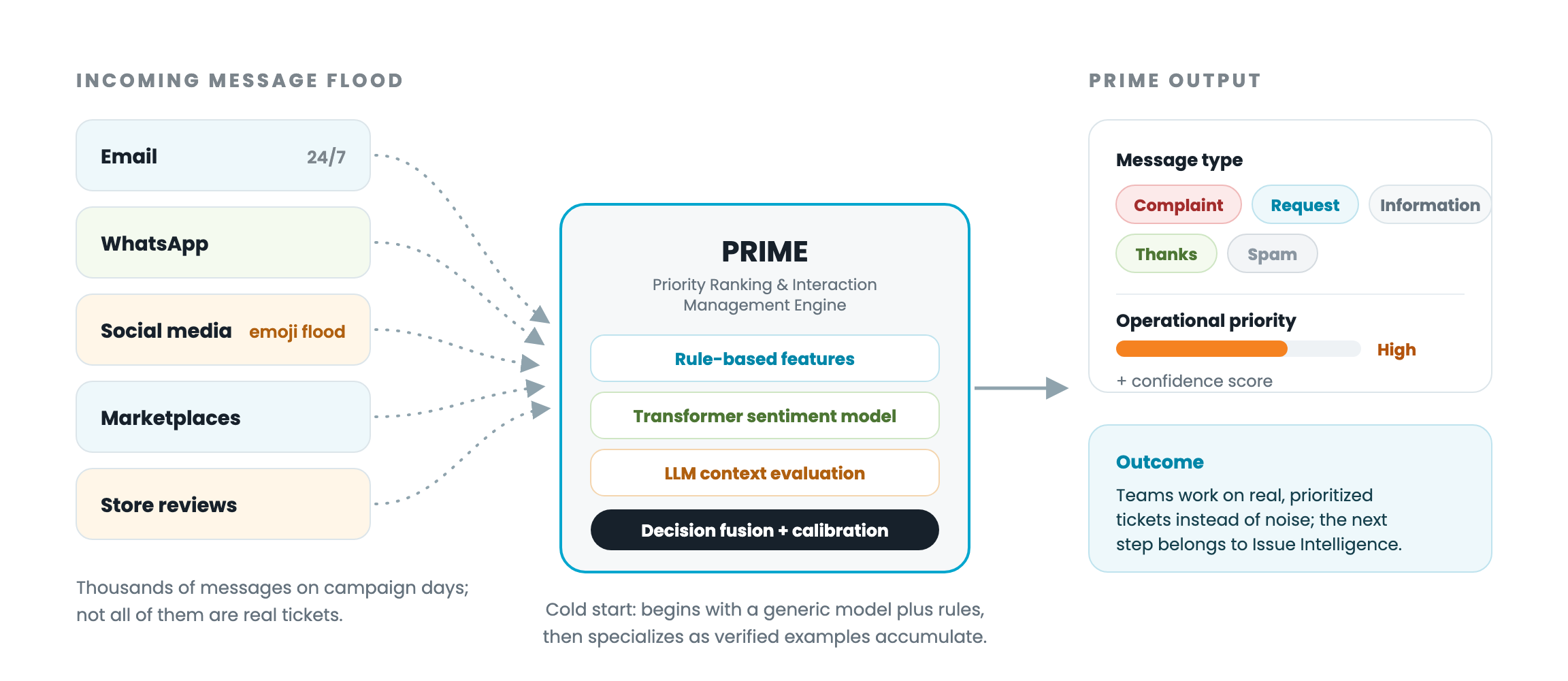
Emojis, short contextless content, irrelevant messages from automated mailing lists and misrouted emails are filtered out at the gate or marked as low priority. Even when thousands of messages arrive on campaign days, teams work on real tickets instead of noise.
Every valid message gets a type — complaint, request, information, thanks or spam — and an operational priority based on the tone, topic and impact of the content. Rule-based features, a transformer sentiment model and LLM context evaluation are fused into a single decision, each produced with a confidence score.
All Touchpoints
No matter where the customer issue comes from, the system applies the same classification principles with advanced content analysis. This creates a shared, learning, and consistent categorization layer instead of different interpretations by different teams.
More AI FeaturesThe most common questions about classifying incoming tickets, using the organization's own category tree and routing to the right team after categorization.
Issue Intelligence analyzes the ticket that has passed PRIME's initial filter; using what it has learned from past tickets and the organization's category tree, it produces the category, priority and routing decision. The ticket's type, subject and context are determined automatically, so the agent does not have to pick a category by hand. The filtering at the door belongs to PRIME, classification and routing to Issue Intelligence. PRIME →
Your own category tree is used; there is no requirement to conform to a predefined scheme. Issue Intelligence places tickets into categories defined the way your organization works and combines that with what it has learned from past tickets. Your existing tree is preserved and classification learns against it; when category definitions change, no new project is needed — the definition is updated in the no-code editor.
Yes. The moment the category is assigned, the ticket is routed to the team, the SLA and the workflow attached to that category; the actions predefined for the category start and the question "who should we assign this to?" disappears. The same problem being assigned to different categories by different agents, and the ticket waiting with the wrong team, are prevented; reports become reliable as well. Team, SLA and flow definitions are managed on the workflow side. Workflow and SLA →
No; whatever the source, the same classification logic is applied. Tickets from email, live chat, WhatsApp, social media, review platforms, marketplaces, the call center and self-service portals are evaluated on a single learning categorization foundation. That creates a shared language instead of different interpretations by different teams, and reduces manual categorization effort and the operational errors that come with it. How the channels are connected is explained on the omnichannel page. Omnichannel →
Yes; every category an agent corrects improves the model's next decision. The corrected example is fed back into training, and as corrections accumulate Issue Intelligence adapts better to your organization's own ticket language and category tree. You can see whether this loop is working in your organization with the maturity test. Maturity test →