
Manage comments and complaints from written channels — email, social media, DMs, marketplaces, complaint sites, etc. — end-to-end automatically with Next4biz AI Agent, trained on your documents, website, experience, and web services:
Monitors support inboxes; filters unnecessary or irrelevant emails. Relevant messages are automatically categorized and converted to notifications.
Monitors Q&A fields on marketplaces (Trendyol, Amazon, etc.). Filters irrelevant content; automatically categorizes relevant messages and converts them to notifications.
End-to-end monitoring of Facebook, Instagram, X, and LinkedIn including comments, mentions, and DMs. Filters noise; automatically categorizes relevant content and converts to notifications.
Monitors review platforms like Google, App/Play Store, Trustpilot. Filters irrelevant content; automatically categorizes relevant reviews and converts them to notifications.
The first step of AI support on written channels is triage. PRIME — Priority Ranking & Interaction Management Engine — listens to all written channels and decides whether each incoming item is a genuine customer ticket that needs handling, and how urgent it is.
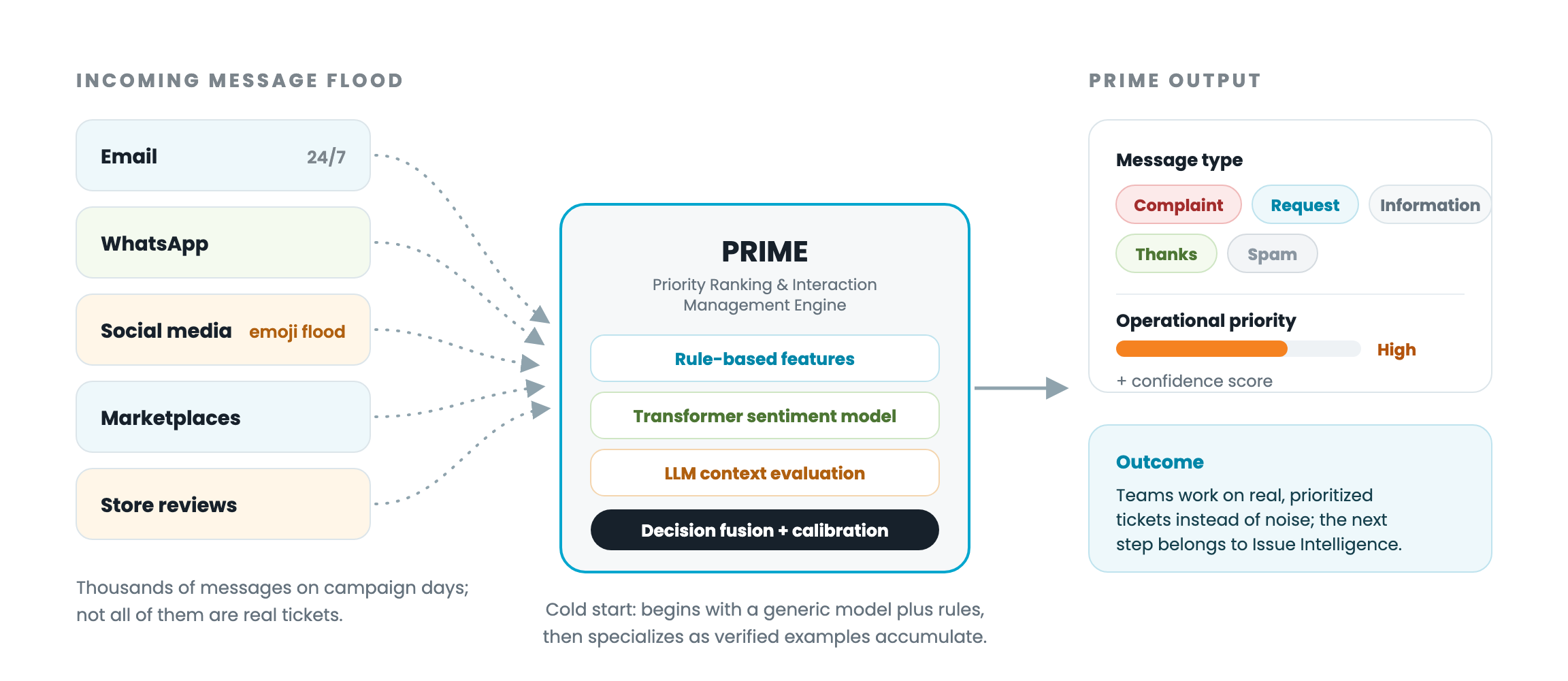
Emojis, short contextless content, irrelevant messages from automated mailing lists and misrouted emails are filtered out at the gate or marked as low priority. Even when thousands of messages arrive on campaign days, teams work on real tickets instead of noise.
Every valid message gets a type — complaint, request, information, thanks or spam — and an operational priority based on the tone, topic and impact of the content. Rule-based features, a transformer sentiment model and LLM context evaluation are fused into a single decision, each produced with a confidence score.
Next4biz has a structure that allows us to make the changes we want. Moreover, it's a local product. We decided to use Next4biz to be able to track our customers' history, facilitate communication between internal departments, and be able to stay with the customer until their ticket is resolved.
Operations Manager / Banking
We went through an adaptation process consisting of 2 parts. While we, as the business team, designed the category tree, interfaces, and processes needed for ticket management by leveraging the Next4biz team's experiences for each of our business channels, the technical teams integrated all our systems.
Customer Experience Director / Insurance
Next4biz's experience especially in e-commerce, being a process-based system, and providing the opportunity to manage marketing, sales, and after-sales services as a whole was our most important reason for preference.
Customer Service Manager / Retail
The questions asked most often about the steps a message from a written channel goes through before it becomes a ticket, what the AI Agent is trained on, and whether replies pass through agent approval.
It monitors email, marketplaces, social media and review platforms. Support inboxes; the question-and-answer areas of marketplaces such as Trendyol, Hepsiburada, Amazon and N11; comments, mentions and DMs on Facebook, Instagram, X and LinkedIn; review sites such as Google, the App/Play Store, Trustpilot and Şikayetvar are all in scope. It filters out irrelevant content, automatically categorizes valid messages and turns them into tickets, prepares a reply in your brand's language and, where needed, starts the relevant workflow.
First filtering, then classification, then the reply. Incoming content passes through PRIME first; noise is filtered out there or marked low priority. The remaining message is placed into the right category in your organization's category tree, becomes a ticket and receives a sentiment label. A draft reply is then prepared, or the workflow attached to the category is started; the agent steps in with a ready draft when needed. PRIME →
On your organization's own sources: your documents, your website, your past resolution experience and your web services. It does not produce answers from general internet knowledge; the answers rest on those sources and are auditable. Answer quality therefore depends on how current the documentation feeding it is. Which language model is used and how your data is processed is explained on the AI page. Our AI approach →
The organization decides, and the decision is made per category. In low-risk categories such as shipment status the reply goes out directly and the ticket closes; in sensitive categories the AI Agent only prepares a draft, and the agent previews it, edits it if necessary and approves it; in some categories it only classifies and prioritizes. Every AI decision is recorded in the ticket history together with its confidence score; the agent's corrections stay visible and improve the model. Maturity test →
Yes. For a question whose category is clear, the AI Agent prepares the answer using the knowledge base, approved templates and data in ERP, CRM or OMS (order status, shipment check); on marketplaces and review platforms it posts the reply back to that platform. Where a transaction such as a return or an exchange is required, the ticket is handed to the relevant workflow and routed to the right team. Even on tickets that reach an agent, the screen is not empty; the agent works from a prepared draft.
Yes. Every ticket the AI Agent creates receives an AI sentiment label, regardless of channel. When a conversation turns negative the ticket is moved forward and, if needed, an alert goes to a manager, so an unhappy customer does not wait in the queue. How sentiment data is aggregated at customer level and turned into churn risk is explained under Churn Analysis. Churn analysis →